
Introduction
A credit builder loan sounds straightforward: you make payments, the lender reports them, and your credit file reflects the activity. The promise is that consistent payment history will improve your score over time. That is the legitimate version. The problem arises when programs are marketed with claims that do not align with how credit reporting actually works — or when the terms themselves create traps rather than opportunities.
When discussing credit builder loans, it is crucial to differentiate between legitimate programs and those that might not have your best interests at heart. A common misconception is that these loans can magically erase negative items from your credit report. However, this belief does not align with the actual statutory text. Many sources claim that certain letters or actions can compel credit deletion within 30 days, but upon examining the relevant sections, such as those concerning disclosure, there is no mention of deletion. This highlights the importance of understanding the mechanisms at play and not falling for myths that circulate widely.
Some credit builder products are structured as closed-end transactions secured by a dwelling, aimed at helping first-time borrowers establish credit history. These products may carry specific regulatory requirements, including mandatory counseling to avoid negative amortization. Understanding the difference between a product designed to build credit through transparent reporting and one that carries hidden risks or unenforceable promises is not a matter of skepticism — it is a matter of reading what the terms actually say and what the law actually requires.
This article walks through how legitimate credit builder loans function, what red flags signal a predatory structure, and how to verify that a program does what it claims. You were not careless if you believed a widely repeated claim. Here is what the mechanism actually looks like, and here is how to tell whether a program is built to help or built to extract fees. For more on how payments are applied and what happens when they are not, see Mortgage Suspense Accounts: Where Your Short Payment Goes.
The Problem with Credit Builder Loans
A credit builder loan sounds straightforward: you borrow a small amount, the lender holds it in a savings account, and you make monthly payments that get reported to the credit bureaus. The loan is designed for people with thin or damaged credit files. When the term ends, you get the money back minus interest and fees. That is the structure. The problem is what happens when the structure is used to sell something else.
Misinformation About What Credit Builder Loans Can Do
Many sources claim that opening a credit builder loan will erase negative items from your credit report within 30 days. This belief does not align with the actual statutory text. The relevant disclosure provisions create no obligation to delete accurate information, and no timeline for removal exists in those sections. A credit builder loan adds a new tradeline to your file. It does not remove an existing one. If a lender or credit-repair marketer tells you otherwise, that claim is not supported by the regulation.
A second widely repeated claim is that making on-time payments on a credit builder loan will automatically offset late payments or charge-offs from other accounts. Payment history is account-specific. A new loan with perfect payment history does not cancel out a delinquent history on a different account. Both appear on the report, and scoring models weigh them independently. The new positive tradeline may improve your score over time, but it does not erase the old negative one.
Predatory Practices in the Credit Builder Loan Market
Some programs steer consumers toward specific counseling organizations or credit-repair services as a condition of approval. When a creditor directs you to choose a particular counselor, that arrangement may indicate a referral relationship rather than an independent recommendation. The regulation prohibits steering in certain mortgage contexts, and the same red flag applies here: if the lender insists on a specific third party, ask why.
Another risk is negative amortization in poorly structured programs. While most credit builder loans are simple installment contracts, some products marketed as credit builders carry terms that allow the balance to grow if payments are missed or if fees compound. The result is a loan that costs more than you borrowed, with no savings to show for it at the end. Read the disclosure that shows the total of payments and compare it to the amount you will receive when the loan matures. If the difference is more than a reasonable interest charge, the product may not be what it appears.
Licensing and Originator Qualifications
Loan originators for consumer credit transactions must be registered and licensed in accordance with applicable State or Federal law, including the SAFE Act. If the person or organization offering you a credit builder loan cannot provide proof of licensure, that is a warning sign. Unlicensed originators may operate outside regulatory oversight, and you may have limited recourse if something goes wrong. Before you apply, verify that the lender or credit union is registered with your state's financial regulator or the NMLS registry.
Understanding these qualification requirements helps you identify legitimate programs and avoid schemes that use credit-building language to sell high-cost products with little benefit. A legitimate lender will disclose its license number and regulatory status without hesitation. If that information is not provided upfront, ask for it in writing.
For related issues with account management and where payments are applied, see Mortgage Suspense Accounts: Where Your Short Payment Goes.
Steps to Identify Legitimate Credit Builder Loans
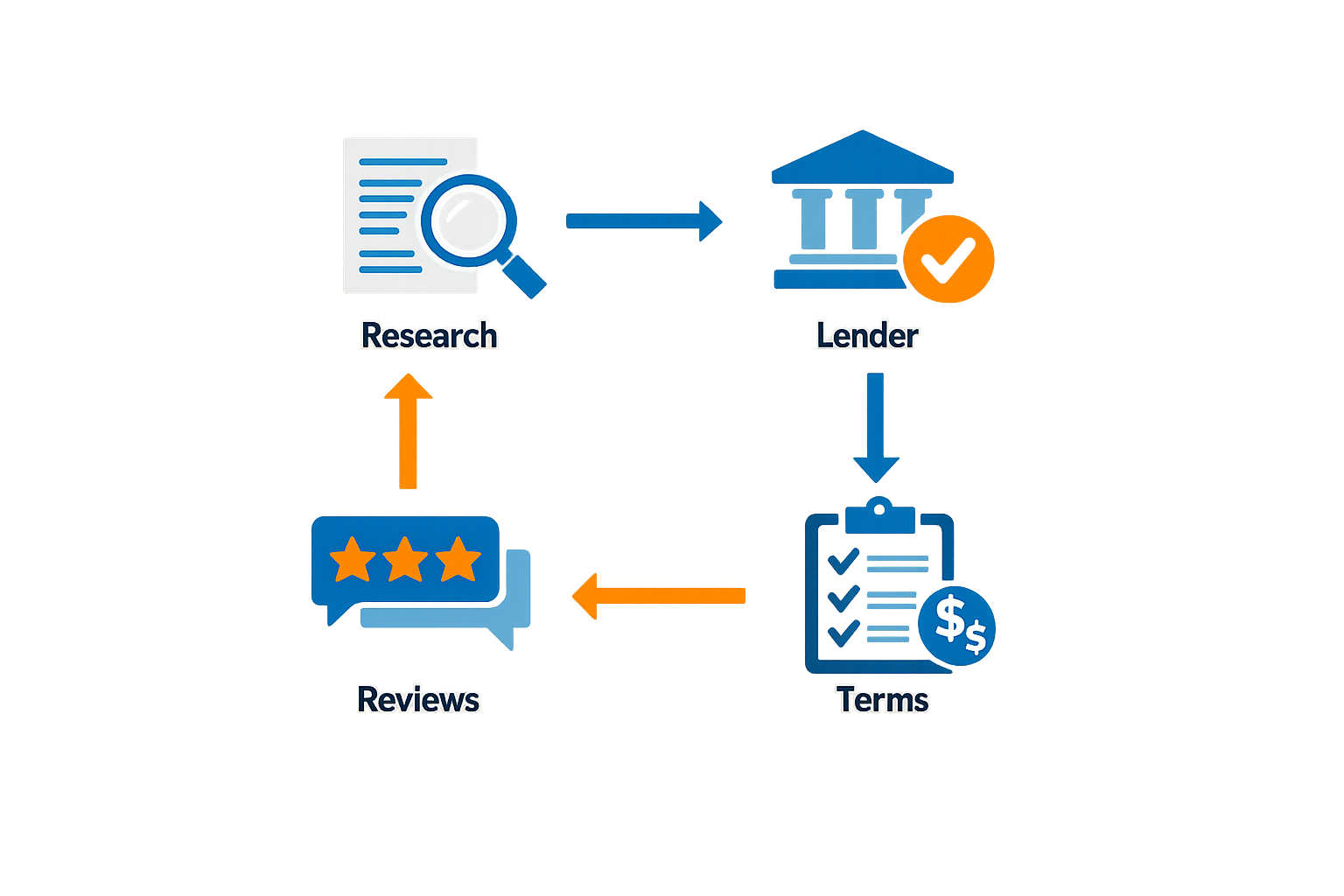
A credit builder loan can be a useful mechanism — or a costly detour. The difference lies in what you check before you sign. Here is what the law requires from the institution offering the loan, and what you can verify to separate a legitimate program from one that will cost you more than it helps.
Verify the Lender's Registration and Licensing
Loan originators for consumer credit transactions secured by a dwelling must be registered and licensed under applicable state or federal law, including the Secure and Fair Enforcement for Mortgage Licensing Act (SAFE Act). While most credit builder loans are unsecured installment products — and therefore not subject to SAFE Act registration — the licensing principle still applies: a legitimate lender operating in your state will hold the required state lending licence or charter.
Check your state's financial regulator website for a licence search tool. Enter the lender's legal name. If nothing appears, or if the licence status shows "suspended" or "revoked," that is a red flag. You are allowed to ask the lender for its NMLS number or state licence number before you apply; a legitimate institution will provide it.
Examine How Credit Terms Are Selected and Presented
Legitimate credit builder loans present terms that are either publicly advertised or selected based on your financial characteristics through a transparent process. Under Regulation Z, a loan originator may establish credit pricing that the creditor offers generally to the public via advertisements or other marketing, or the originator may offer particular credit terms selected based on your financial characteristics — but only after orienting you to the process, assisting you to apply, and negotiating terms in a documented manner.
If an offer arrives unsolicited with no application, no inquiry about your income or credit history, and a demand for an upfront fee before you see the loan agreement, that sequence does not match the regulatory framework. A legitimate program will ask for your financial information, explain how your rate and term were determined, and provide a written disclosure before any money changes hands.
Step 1
Request a written disclosure before paying anything
Ask for the loan agreement, the payment schedule, and the total cost in writing. A legitimate lender will provide these documents before you pay an application fee, a processing fee, or any other charge. If the institution says you must pay first to "unlock" the terms, that is not how legitimate credit products work.
Step 2
Confirm that payments will be reported to the bureaus
The only reason to use a credit builder loan is to establish a payment history. Ask the lender which credit bureaus will receive your payment data and when reporting begins. A legitimate program will name the bureaus — usually Equifax, Experian, and TransUnion — and will report monthly. If the answer is vague, or if the lender says reporting is "optional" or "upon request," the product will not build your credit.
Step 3
Check for compliance with background and credit report protocols
For mortgage-related loan originators, federal rules require a criminal background check through the Nationwide Mortgage Licensing System and Registry and a credit report from a consumer reporting agency, secured in compliance with the Fair Credit Reporting Act. While credit builder loans are typically unsecured and not mortgage transactions, a legitimate consumer lender will still pull your credit report through permissible-purpose channels and will provide you with an adverse-action notice if your application is denied or your rate is increased based on your credit file. If the lender never pulls your credit or never sends an adverse-action notice after a denial, that suggests the institution is not following standard compliance procedures.
Understand What the Product Actually Does
A credit builder loan does not erase negative items from your credit report. It adds a new installment tradeline and, if you make every payment on time, it adds positive payment history. That is the mechanism. There is no statutory provision that compels deletion of accurate negative information simply because you opened a new account.
If a lender or a third-party marketer claims the loan will "remove collections," "erase charge-offs," or "guarantee a score increase of X points," that claim is not supported by the relevant sections of the Fair Credit Reporting Act or Regulation V. What Regulation V requires is accuracy of what was furnished — not fairness of the underlying charge, and not deletion of verified data. You were not careless for not knowing this; the widely repeated version is wrong.
For more on how payment data moves from your account to your credit file, see Mortgage Suspense Accounts: Where Your Short Payment Goes.
A credit builder loan adds payment history; it does not subtract verified negative information.
Compare Fees to the Loan Amount
Legitimate credit builder loans typically involve a small loan — often between $300 and $1,000 — held in a savings account or certificate of deposit while you make monthly payments. At the end of the term, you receive the principal minus interest and any fees. The total cost should be modest: an interest rate comparable to a personal loan (often in the range of 6–16% APR) and minimal or zero fees beyond interest.
If the fees — application fee, monthly servicing fee, early-closure fee — add up to more than 10% of the loan amount, or if the interest rate exceeds 36% APR, the product is expensive relative to the benefit. Run the numbers: if you are paying $150 in fees and interest to borrow $500 for 12 months, you are spending 30% of the loan amount for a single tradeline. That is not necessarily predatory, but it is costly, and you should compare it to alternatives such as a secured credit card with no annual fee.
| Feature | Legitimate Program | High-Cost Program |
|---|---|---|
| Fees as % of loan | Under 10% | 15% or more |
| APR | 6–16% | 25–36% or higher |
| Bureau reporting | All three bureaus, monthly | Vague or "upon request" |
| Upfront payment required | Application fee only, disclosed | Multiple fees before disclosure |
| Deletion or score guarantee | None | Promised or implied |
Tips and Tricks for Successful Credit Building
A credit builder loan is a financial product designed to help individuals build or improve their credit score by requiring them to make regular payments. The money you pay sits in a holding account until the loan is paid off, and the payment history is reported to the credit bureaus. What matters is that the payments are reported on time and in full — that is what builds the file.
Set Up Automatic Payments
The simplest way to ensure on-time payment is to automate it. Most credit builder loan programs allow you to link a checking or savings account and schedule payments to leave on the same day each month. Check your statement to confirm the payment posted and the date it was reported. If a payment is coded as late even though it left your account on time, that goes to how the servicer applied it, not whether you sent it.
Understand What Gets Reported
The payment history that appears on your credit file is what the lender furnishes to the bureaus. Under Reg V, the focus is on the accuracy of what was furnished rather than the fairness of the underlying charge. If you see a late payment on your report and you believe it is wrong, the field you are disputing is the payment status for that specific month. You can send a direct dispute to the furnisher or file a dispute through the bureau; either way, put the request in writing and keep the tracking number.
Monitor Your Credit File Regularly
You are allowed to request your credit report from each of the three major bureaus once per year at no cost. Review the file for accuracy: confirm that the credit builder loan appears, that the payment history matches your records, and that the account status is current if you are up to date. If something looks wrong, identify the exact field that is incorrect and dispute it with the bureau or the furnisher. There is no reason you would have known which field to look at without checking the report first.
Avoid Common Credit-Repair Myths
A widely repeated version of credit building is that certain letters or actions can compel deletion of accurate information within 30 days. Upon examining the relevant statutory text, such as sections concerning disclosure, there is no mention of deletion. Mortgage suspense accounts operate on a similar principle: the payment arrives, but if it does not meet the full amount due, it sits in a holding account rather than being applied to the loan. The same logic applies to credit builder loans — the mechanism works as designed, and understanding that mechanism is what protects you from schemes that promise outcomes the law does not require.
What builds your credit is the reported payment history, not the marketing language around the loan.
Keep Records of Every Payment
Save confirmation numbers, bank statements showing the withdrawal, and any correspondence with the lender. If a dispute arises later, these records are what you will need to show that the payment was made and when. The term of art is "proof of payment," and it includes the date the payment left your account, the amount, and the account it was applied to. If the lender claims a payment was late or missing, your records are the first line of defense.
Know Where to Send a Complaint if Something Goes Wrong
If you send a notice of error or request for information about your credit builder loan and the response is inadequate, you can file a complaint with the Consumer Financial Protection Bureau or your state's financial regulator. The complaint should describe what you asked for, what the lender sent back, and why the answer does not resolve the issue. Keep a copy of everything you send. The clock starts when the lender receives your request, and they have to respond within the window the regulation sets — typically 30 days for a notice of error under Reg X, though that regulation applies to mortgage servicing and may not govern your credit builder loan. Check which law applies to your specific product.
Conclusion
Credit builder loans can be a useful tool when you understand how they work and what they can and cannot do. The mechanism is straightforward: you make payments, the lender reports them, and the payment history appears on your credit file. What they do not do is erase existing negative items. A widely repeated claim is that certain dispute letters can force deletion within 30 days, but the statutory text contains no such provision. The relevant sections address disclosure, not deletion, and the duties under Reg V focus on the accuracy of what was furnished rather than the fairness of the underlying charge.
When evaluating a credit builder loan, check whether the lender is properly licensed and whether the terms are clear before you sign. Loan originators must be registered and licensed in accordance with applicable state and federal law, including the Secure and Fair Enforcement for Mortgage Licensing Act. If a program makes promises about score increases or guaranteed deletions, those are red flags. No one can predict how a bureau's scoring model will respond to a new tradeline, and no letter template creates an obligation to remove accurate information.
If you are managing other servicing issues—such as payments held in suspense or escrow shortages—understanding your rights under the relevant regulations can help you address those problems separately. For example, mortgage suspense accounts explain where a partial payment goes and why it may not be applied to your loan balance immediately.
You were not careless if you believed a claim about rapid credit repair. The marketing language is pervasive, and there is no reason you would have known that the statute does not support it. What matters now is that you have the facts: a credit builder loan reports payment history, it does not delete past delinquencies, and any program that promises otherwise is selling something the law does not provide. Focus on making the payments on time, keeping the documentation, and checking your file to confirm the tradeline is being reported as agreed.