Introduction
FICO vs VantageScore is the choice lenders make, not the choice you make. You apply for a mortgage. The lender pulls your credit and quotes a rate. You check your score on a credit-monitoring app the same day and see a number thirty points higher. The difference is not an error. You are looking at two different scoring models: one built by FICO, the other by VantageScore. Both companies license their formulas to lenders and consumer platforms, and the results often diverge.
The question is not which score is more accurate. Both models read the same credit report — the payment history, balances, and account ages the bureaus maintain. The question is which score the lender uses when deciding whether to approve your application and at what rate. That choice determines which number matters for that transaction.
Most mortgage, auto, and credit-card lenders use a FICO score. Some use VantageScore. A few check both. There is no federal rule that requires a lender to use one model over the other. The lender discloses which score it pulled after it makes a credit decision, but by then the application is already in process. Knowing in advance which model a lender relies on lets you track the number that will actually appear on the underwriter's screen.
This comparison walks through how each model works, what drives the differences, and which score you should monitor for mortgage reinstatement requirements and disclosures or other credit decisions. The goal is not to pick a winner. The goal is to show you which number to watch and why the other one may not matter for your next application.
Understanding the differences between FICO vs VantageScore is necessary for making informed financial decisions, because each model may yield different scores based on the same financial data. The rest of this article breaks down the mechanics, the pricing, and the practical implications of each model so you know which score to trust when it counts.
FICO vs VantageScore explained: understand which credit score lenders use for mortgages, auto loans, and credit cards—and which one you should monitor.
Overview of FICO
FICO is a credit scoring model that lenders use to evaluate a consumer's creditworthiness based on their financial characteristics. The model translates credit-file data into a three-digit number, and that number influences whether you are approved for a loan, what interest rate you pay, and sometimes whether a creditor will negotiate payment terms. FICO scores range from 300 to 850, with higher numbers indicating lower predicted risk.
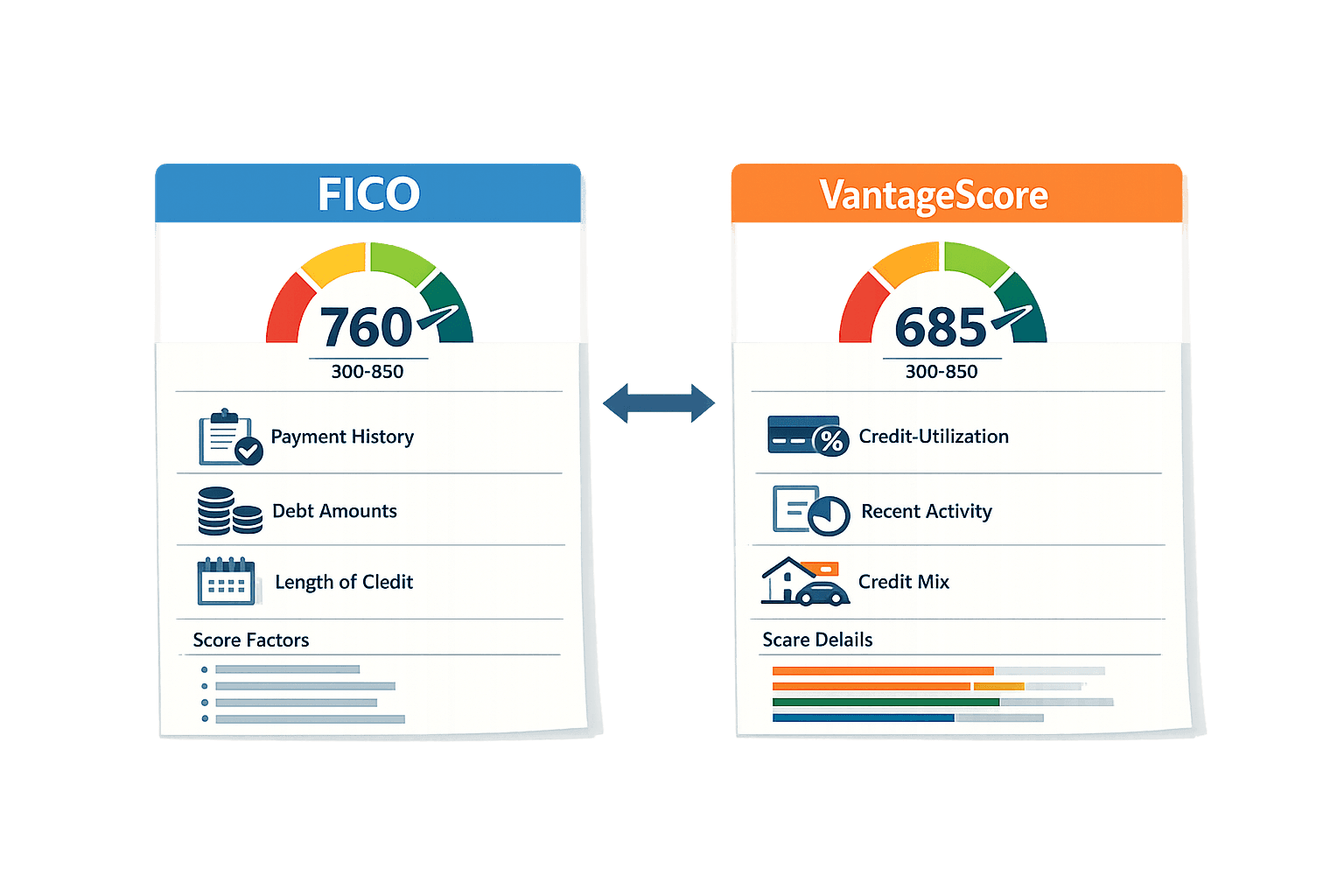
The model weighs five categories of information: payment history, amounts owed, length of credit history, credit mix, and new credit. Payment history carries the most weight — late payments, charge-offs, and collection accounts pull the score down. Amounts owed looks at how much of your available credit you are using; maxing out a card signals higher risk even if you pay on time. Length of history rewards older accounts, credit mix considers whether you manage different types of credit, and new credit tracks how many recent applications you have made.
What FICO Means on Your Statement
When a lender pulls your credit, the number you see is often a FICO score, though the exact version varies by product. Mortgage lenders typically use older FICO models — FICO 2, 4, and 5 — because those versions are embedded in the automated underwriting systems that Fannie Mae and Freddie Mac require. Auto lenders and card issuers may use newer versions that weigh certain tradelines differently. The score on your statement may not match the score a lender sees, because consumer-facing scores often come from a different version or a different bureau.
You do not choose which FICO version a lender pulls. The lender's underwriting policy dictates that. If you are comparing offers, ask which score and which bureau the lender uses, so you know which number on your own report is relevant. For mortgage applications, understanding mortgage suspense accounts can also clarify how partial payments affect your standing during the approval process.
How FICO Became the Standard
FICO launched in 1989 and became the default because the three major credit bureaus — Equifax, Experian, and TransUnion — adopted it early. Fannie Mae and Freddie Mac later required FICO scores for mortgage purchases, which locked the model into the secondary market. That regulatory endorsement made FICO the standard for decades. Lenders trust it because it has a long performance history and because the secondary market accepts it without question.
The model updates periodically. FICO 8 is common for credit cards, FICO 9 introduced changes to medical-collection weighting, and FICO 10 incorporates trended data. Older versions remain in use because changing an underwriting system is expensive and because regulators and investors have validated those versions over time. There is no universal upgrade cycle — a lender may use FICO 5 for mortgages and FICO 8 for cards at the same time.
Overview of VantageScore
VantageScore is a credit scoring model developed jointly by the three major credit bureaus — Equifax, Experian, and TransUnion. It was introduced in 2006 as an alternative to FICO, with the goal of creating a more consistent scoring approach across all three bureaus. Where FICO maintained separate proprietary models, VantageScore offered a unified methodology that all three bureaus could implement.
The current version, VantageScore 4.0, uses a 300–850 scale, matching the range most consumers recognize. Earlier versions used different ranges, which caused confusion; that inconsistency has been resolved. VantageScore evaluates creditworthiness based on a consumer's financial characteristics, including payment history, credit utilization, length of credit history, types of credit used, recent credit inquiries, and available credit. The weighting of these factors differs from FICO's approach, and VantageScore can generate a score for consumers with shorter credit histories — sometimes after just one month of activity on a single account.
Where VantageScore Appears
You are more likely to see a VantageScore when you check your own credit through a monitoring service, a credit card issuer's free score feature, or a personal finance app. Many consumer-facing tools display VantageScore because the bureaus license it broadly and at lower cost than FICO. That does not mean lenders use it to make decisions. The score you see on your app and the score a mortgage underwriter pulls are often different models entirely.
Some lenders do use VantageScore for decisioning, particularly in auto lending, credit card approvals, and personal loans. The adoption rate has grown, but it remains the minority choice. When you apply for a mortgage, the underwriter will almost always pull a FICO score, not a VantageScore. For more on how servicers handle account activity and disclosures, see Mortgage Suspense Accounts: Where Your Short Payment Goes.
How VantageScore Differs in Calculation
VantageScore groups factors into six categories, each with a different influence level. Payment history carries the most weight, followed by age and type of credit, credit utilization, total balances, recent credit behavior, and available credit. The exact percentages are proprietary and shift slightly between versions. One notable difference: VantageScore treats all inquiries within a 14-day window as a single event, regardless of loan type. FICO's shopping window is longer — typically 45 days — and applies only to certain loan categories like mortgages and auto loans.
Another distinction is how the models handle collections and paid judgments. VantageScore 3.0 and 4.0 ignore paid collection accounts entirely, while FICO continues to factor them in, though with reduced impact in newer versions. Medical collections under a certain dollar threshold may also be excluded by VantageScore. These differences can produce meaningfully different scores for the same credit file, especially if you recently paid off a collection or had medical debt.
What the Score Does Not Tell You
A VantageScore is a number derived from the data in your credit file at the time the score is calculated. It does not explain why a payment was coded a certain way, why a disputed item remains on your report, or what a lender's internal underwriting criteria require. The score is not a legal finding, and it does not determine whether a furnisher violated a reporting obligation. If you see an inaccuracy, you dispute the underlying data with the bureau or the furnisher directly — the score recalculates automatically once the file is corrected.
The term of art for that process is a direct dispute when you contact the furnisher, or a reinvestigation when you go through the bureau. Neither process requires you to reference your score or cite a specific model. You identify the account, state what is wrong, and the furnisher has a statutory window to investigate and respond. The widely repeated version — that disputing through the bureau is faster or more effective — is wrong. Both paths trigger the same furnisher obligations; the difference is who receives your letter first.
Feature Comparison of FICO vs VantageScore
The two models calculate your score from the same three credit files, but they weight the data differently and treat certain events in ways that can shift your number by twenty or thirty points. Here is what changes when you move from one model to the other.
Scoring range and what the numbers mean
Both FICO vs VantageScore now use a 300–850 scale, so a 720 under either model sits in the same numerical band. Older VantageScore versions ran 501–990; if you see a score above 850 on a monitoring site, check which version the site is using. The range itself does not tell you which lenders rely on that model.
How payment history is weighted
FICO gives payment history 35 percent of the total score. VantageScore calls payment history "extremely influential" but does not publish exact percentages. In practice, a thirty-day late mark will hurt under both models; the difference appears when you carry a mix of trade lines. FICO treats a missed mortgage payment more severely than a missed retail card, while VantageScore applies a flatter penalty across account types. Neither model ignores the late payment, but the size of the drop depends on what else is in the file.
Credit utilisation and the reporting window
FICO looks at the balance reported on your statement date, even if you pay in full every month. VantageScore can incorporate trended data—the pattern of balances over several months—when the furnisher sends it. That means VantageScore may recognise that you cycle a high balance but always pay it off, while FICO sees only the snapshot. Not every furnisher reports trended data, so this feature matters more in theory than in every scored file.
How each model treats thin files and new credit
VantageScore can generate a score with as little as one account that is one month old. FICO requires at least one account six months old and at least one account reported in the past six months. If you are new to credit or rebuilding after a period with no active trade lines, VantageScore will often produce a number when FICO returns "insufficient credit history." That does not mean lenders will approve the application—it means you have a score to see.
Collections, medical debt and paid accounts
FICO 8, still the most widely used mortgage-underwriting score, counts all collection accounts, paid or unpaid. FICO 9 and later versions ignore paid collections and give less weight to medical collections under $500. VantageScore 3.0 and 4.0 both ignore paid collections and apply a lower penalty to medical debt. If your file shows a paid medical collection, VantageScore will usually return a higher number than FICO 8, and FICO 9 will fall somewhere in between. Mortgage Suspense Accounts: Where Your Short Payment Goes explains what happens when a partial payment sits unapplied, which can trigger a late mark that both models will see.
Hard inquiries and new-account impact
Both models allow rate shopping: multiple auto or mortgage inquiries within a short window count as one inquiry. FICO uses a 45-day window for FICO 8 and a 14-day window for older versions still in use. VantageScore uses a 14-day window across all versions. A single credit-card inquiry will lower both scores by a few points, and the effect fades after a year. The difference is not large enough to change an approval decision on its own.
What shows up on a monitoring site versus a lender pull
Most free monitoring sites show VantageScore 3.0 because the license is cheaper and the score updates quickly. When you apply for a mortgage, the lender pulls FICO 2, 4 and 5—versions released in the 1990s that do not ignore paid collections and do not use trended data. Auto lenders often pull FICO Auto Score 8 or 9, which weight auto-loan history more heavily. The score you see for free is usually not the score the underwriter sees, regardless of which model your monitoring site uses.
Which differences matter in practice
If your file is clean—no lates, no collections, balances under 30 percent, mix of trade lines older than two years—FICO vs VantageScore will return similar numbers, often within ten points. The models diverge when your file contains paid collections, recent medical debt, a thin history, or a pattern of high statement balances that you pay off monthly. In those cases, VantageScore will usually show a higher number, but that higher number does not control what the lender decides.
Pricing Comparison
Neither FICO nor VantageScore charges you directly when a lender pulls your score. The lender pays the bureau, and the bureau pays the scoring company. What you pay — if anything — depends on where you look and what you are trying to accomplish.
Most free credit monitoring services show a VantageScore 3.0. The three bureaus offer free weekly reports under federal law, but the score included is usually VantageScore. If you want a FICO score, you typically pay for it through myFICO.com or a paid monitoring service. A single-bureau FICO score costs around $20; a three-bureau report with multiple FICO versions can run $60 or more.
What Lenders Pay
Lenders pay per inquiry. A mortgage lender pulling a tri-merge report with FICO scores pays the bureaus a combined fee that covers data and scoring. The exact amount varies by volume and contract, but the cost to the lender is built into origination expenses. VantageScore licenses its model to the bureaus, which then sell scored reports to creditors. The pricing structure is opaque, but both models generate revenue from institutional users rather than consumers.
Monitoring and Dispute Costs
If you are monitoring your file to prepare for a dispute or to track changes after sending a notice of error, the free weekly bureau reports give you the data fields you need. The score itself — FICO vs VantageScore — does not change the dispute process. Paying for a score makes sense when you are shopping for a mortgage and want to see the version the lender will use, or when you are comparing offers and need to know where rate tiers break. Outside those windows, the free VantageScore is sufficient for tracking account status and verifying that disputed items updated.
Some creditors provide a free FICO score on your monthly statement. Discover, for example, shows FICO Score 8 for all cardholders. If your primary card offers this, you have one FICO version at no cost. That score will not match the mortgage FICO versions, but it tracks the same direction and responds to the same behaviors.
When Paying Makes Sense
Pay for a FICO report when you are within 60 days of applying for a mortgage, auto loan, or other installment credit that uses a specific FICO version. Pay for a three-bureau report if you do not know which bureau the lender will pull. Otherwise, the free weekly reports and any free scores your creditors provide are enough to monitor your file and confirm that corrections took effect.
Pros and Cons of Each Score
Both scoring models have advantages and limitations that matter when you are applying for credit or reviewing your file. Understanding what each model does well — and where it falls short — helps you interpret the number you see and decide which score to monitor.
FICO Strengths and Weaknesses
FICO's primary advantage is lender adoption. Most mortgage, auto and credit-card underwriters pull a FICO score, so that is the number that determines your rate and approval. The model has decades of validation data, and creditors trust its predictive accuracy. FICO also offers industry-specific scores — auto-enhanced and mortgage-enhanced versions — that adjust the weighting for the loan type.
The trade-off is complexity. FICO publishes multiple versions (FICO 8, FICO 9, FICO 10 T), and lenders do not all use the same one. A mortgage servicer may pull FICO 5 from Equifax, FICO 2 from Experian and FICO 4 from TransUnion, then take the middle score. You can buy your FICO 8 from myFICO and still not see the exact number the underwriter used. FICO also requires a longer credit history to generate a score, which leaves some thin-file consumers unscored.
VantageScore Strengths and Weaknesses
VantageScore's main benefit is accessibility. The model can score a consumer with as little as one month of history and one account, whereas FICO typically needs six months. VantageScore also treats trended data — whether your balances are rising or falling — which can help consumers who are paying down debt. The single-version approach (VantageScore 4.0 is the current release) makes the score easier to explain, and many free credit-monitoring services display a VantageScore because the licensing terms are more flexible.
The disadvantage is limited lender uptake. Most mortgage and auto lenders do not use VantageScore in underwriting, so a strong VantageScore may not translate to approval. The score you monitor for free may differ significantly from the FICO score a creditor pulls, and that gap can be confusing when you apply. VantageScore also weighs recent behavior more heavily, which means a single late payment can cause a larger swing than it would under FICO.
The absence of any significant adverse information is sufficient to support an affirmative determination that an individual meets financial-responsibility standards — but lenders still prefer the scoring model they have validated internally.
What the Trade-Offs Mean for Monitoring
If you are preparing for a mortgage or auto loan, tracking your FICO score gives you the closest preview of what the lender will see. If you have a thin file or are rebuilding after a period of inactivity, a VantageScore may be the only number available, and it can show progress sooner. Neither score is inherently better; they measure risk through different lenses, and the one that matters is the one your creditor pulls. For a deeper look at how payment history and account types influence your file, see loss mitigation appeal timelines.
Many consumers assume that bankruptcies and foreclosures disqualify them permanently. Financial-responsibility assessments under federal originator rules consider these events only if they occurred within a recent timeframe, and the weight depends on the full picture — not a single line item. Check your report for the date of any adverse mark, and understand that context matters more than the event itself.
Who Should Choose What?
You do not choose which score a lender uses. The lender chooses the scoring model and the bureau file it pulls, and that choice is not disclosed before you apply. What you can do is understand which score is more likely to matter for the transaction you are planning, so you know what to monitor and where to focus any dispute or correction work.
When FICO Is What the Lender Will Use
Mortgage underwriting relies on FICO scores almost exclusively. The same is true for most auto loans and many personal loans issued by banks and credit unions. If you are applying for a mortgage, the lender will typically pull FICO scores from all three bureaus and use the middle score, or the lower of two if only two are available. That means the FICO score you see on a credit-monitoring dashboard may not be the one the lender uses, because FICO offers industry-specific versions. Mortgage lenders use older FICO models—often FICO 5, 4, and 2 from the three bureaus—while auto lenders may use FICO Auto Score 8 or 9. The term of art is "classic FICO," and it is what most creditors mean when they say "credit score" in underwriting guidelines.
If you are preparing for a mortgage application, you should request your FICO scores directly from myFICO or from a credit-card issuer that provides them as a cardholder benefit. Many large card issuers now show a FICO score on the monthly statement or in the online account portal. Check which FICO version is displayed; if it is FICO 8 or 9, it will be close to but not identical to the mortgage score. The widely repeated version of this is wrong: the score your card issuer shows you is not a "fake" score, but it may be a different FICO model than the one a mortgage lender pulls.
When VantageScore Is What You Will See
Most free credit-monitoring services, including those offered by Credit Karma, Credit Sesame, and many bank and card-issuer portals, display VantageScore 3.0. VantageScore is also the model used by many tenant-screening services and by some personal-loan and credit-card issuers, particularly fintechs and online lenders. If you are monitoring your credit to watch for fraud, to track dispute outcomes, or to see whether a paid collection has updated, VantageScore will show you those changes quickly, because it updates whenever the bureau file updates. The score itself may not be the one a lender uses, but the underlying data—the payment history, the balances, the public records—will be the same data any scoring model sees.
VantageScore is also useful if you have a thin file or are rebuilding after a bankruptcy or other derogatory event. VantageScore can generate a score with as little as one month of credit history and one account reported in the past 24 months, while FICO typically requires six months of history. That does not mean a lender will approve you with a thin file, but it does mean you can see a score and track progress earlier in the rebuilding process. If you are working with a credit counselor or a housing counselor, ask which score the counselor monitors; many use VantageScore because it is available at no cost through Credit Karma and similar platforms.
When the Difference Does Not Matter
If your credit file is clean—no late payments, no collections, no high balances, no recent inquiries—your FICO vs VantageScore will be close, often within 20 points. In that case, the model does not matter much, because you will qualify for prime or near-prime rates under either system. The difference matters most when your file contains something negative or borderline: a recent late payment, a medical collection, a high credit-card balance, or a short credit history. FICO vs VantageScore treat these items differently, and a 30-point gap can move you from one rate tier to another.
If you are not applying for credit in the near term, monitor whichever score is free and easy to access, and focus on the behaviors that improve both models: pay on time, keep balances low, avoid new inquiries, and dispute any inaccurate information as soon as you see it. The field you are disputing is the same regardless of the scoring model, and the correction will affect both FICO vs VantageScore once the bureau updates the file. For guidance on where your short payment goes and how it affects your account status, see the linked explainer on suspense-account mechanics.
What to Do When You Need a Specific Score
If you are applying for a mortgage or an auto loan and you need to know your FICO score before you apply, purchase it directly from myFICO. The site offers a one-time report or a monthly monitoring subscription, and it will show you the specific FICO versions that mortgage and auto lenders use. The cost is higher than a free VantageScore, but the score is the one the lender will see. If you are applying for a credit card or a personal loan and the issuer does not disclose which model it uses, assume FICO unless the issuer is a fintech or an online-only lender, in which case it may use VantageScore. There is no public registry of which lenders use which model, so if the decision is close, you can ask the lender directly before you apply. Many will tell you, and some will pre-qualify you with a soft inquiry that does not affect your score.
If you are working to improve your score and you see a large gap between your FICO vs VantageScore, the gap usually points to a specific issue: a medical collection that VantageScore ignores but FICO counts, or a thin file that VantageScore can score but FICO cannot. Identify the issue, correct it if it is inaccurate, and track the change in both scores. The term of art for this is "score factor" or "reason code," and both FICO vs VantageScore will show you the top factors affecting your score when you pull a report. Use those factors to prioritize what to fix first.
Final Verdict
The question of FICO vs VantageScore is not which one is better — it is which one the lender will use. FICO scores appear in the overwhelming majority of mortgage, auto loan and credit card underwriting decisions. VantageScore is used in some pre-qualification tools, tenant screening and a handful of card issuers, but it remains the minority model in actual lending. If you are applying for a mortgage, the lender will pull a FICO score. If you are monitoring your credit for free through a bank portal or credit-monitoring service, you are probably seeing a VantageScore.
Understanding the differences between FICO vs VantageScore is crucial for making informed financial decisions, as each model may yield different scores based on the same financial data. The two models weigh payment history, utilization and credit age differently. They handle collections, medical debt and thin files in distinct ways. A 720 FICO is not the same risk profile as a 720 VantageScore, and a lender knows that. The score you see on your app may not be the score the lender sees, and that gap can be twenty or thirty points in either direction.
What Matters When You Apply
When you submit an application, the institution orders a score from one or more bureaus using the model written into its underwriting policy. Fannie Mae and Freddie Mac require specific FICO versions for mortgages. Auto lenders typically use FICO Auto scores. Card issuers may use FICO Bankcard scores or a proprietary model built on FICO architecture. VantageScore appears in some instant-decision flows and account-review processes, but it does not dominate any major credit category. Knowing which score a lender uses tells you which number to track.
You cannot choose your score. You can choose which monitoring tool you use, and you can ask the lender which model it pulls. If the lender uses FICO 8 and your monitoring service shows VantageScore 3.0, the two numbers will not match. That does not mean either one is wrong — they are answering different questions using different formulas. What you can control is the underlying behavior: pay on time, keep balances low, do not close old accounts, and avoid unnecessary inquiries. Those actions improve both scores.
Monitoring Both Models
Tracking a VantageScore costs nothing and gives you early warning when something changes on your file. A sudden drop in your VantageScore often means a new collection, a missed payment or a utilization spike — events that will also hurt your FICO score. The VantageScore is not useless; it is a proxy. It tells you the direction of travel. If your VantageScore climbs twenty points, your FICO score is probably climbing too, even if the absolute numbers differ.
For mortgage applicants, FICO is not optional. The conforming-loan market runs on FICO 2, 4 and 5, and those versions treat authorized-user accounts and collections more harshly than FICO 8 or VantageScore 3.0. If you are six months from applying, order the mortgage-specific scores and address any surprises now. For renters, personal-loan borrowers and people rebuilding after a thin file, VantageScore may be the model the screener uses, and it rewards on-time rent and utility payments in some versions. Know what the decision-maker will see, then optimize for that model.
The score you see on your app may not be the score the lender sees, and that gap can be twenty or thirty points in either direction.
There is no reason you would have known which model a lender uses unless you asked or read the fine print. Most people discover the difference when their monitoring score looks fine and the loan officer quotes a higher rate. The term of art is "score disclosure" — lenders must tell you if they used your credit report in an adverse action, and they must identify the score. If the number does not match what you expected, that disclosure tells you which model mattered. Next time, you will know which one to track.
In the end, FICO vs VantageScore is a question of application context. FICO dominates lending; VantageScore dominates free monitoring. Both reflect the same credit file. Both respond to the same good habits. The verdict is not one or the other — it is knowing which one the institution will use and preparing accordingly. For more on how mortgage servicers handle account activity and disclosures, see how long you can stay in loss mitigation review.