Introduction
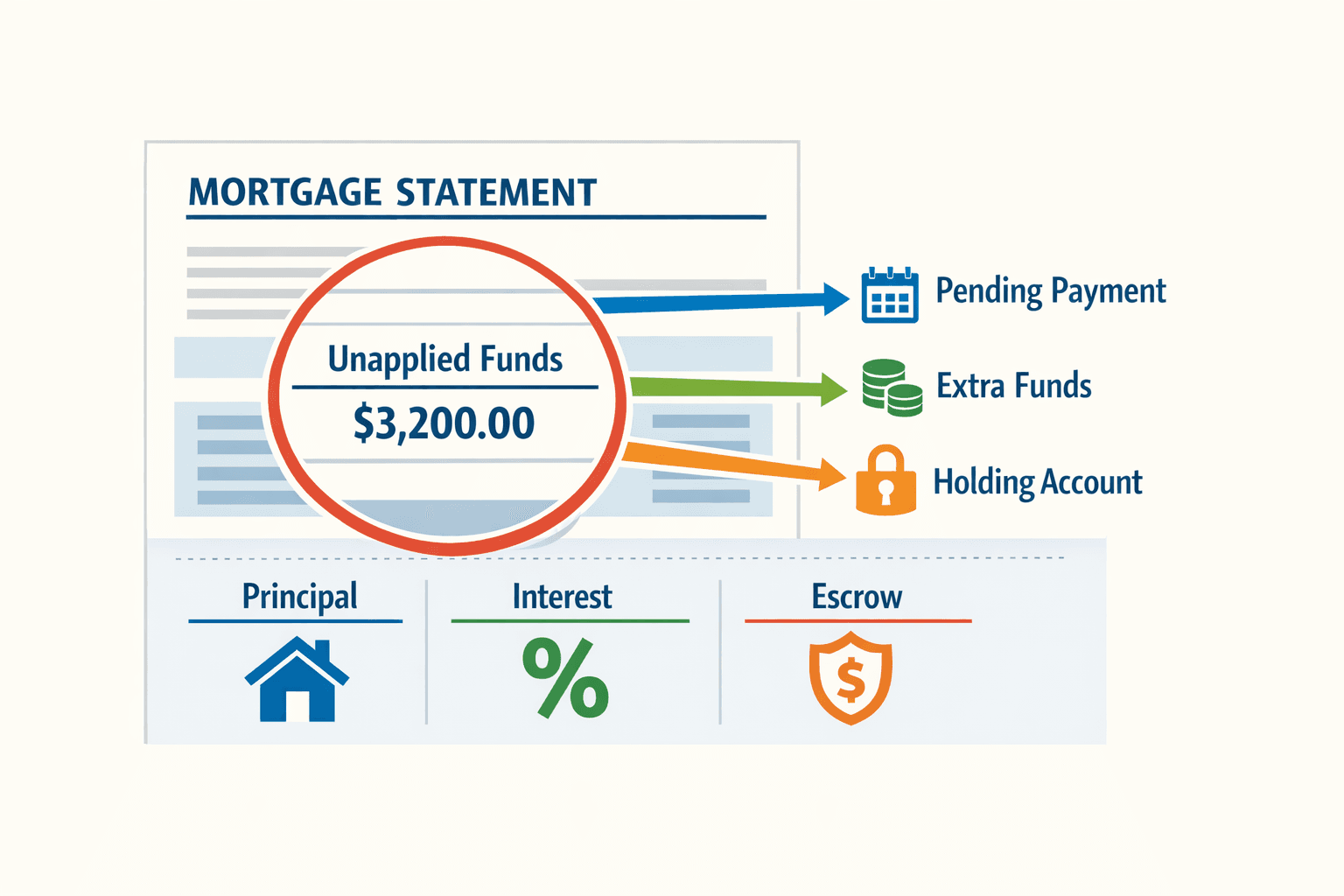
An unapplied funds mortgage statement line appears when a payment arrives on time, clears your bank account, and still leaves your mortgage delinquent. The money is not missing—it is sitting in a holding account the servicer calls a suspense or unapplied-funds account. Nothing on the face of the statement may explain why the servicer chose to hold the funds rather than apply them, and you may only discover the problem when you receive a late notice or check your payment history.
This happens to a lot of people. Servicers are required under § 1026.41(d)(3) of Regulation Z to disclose partial payments that were placed in a suspense or unapplied-funds account since the previous statement, as well as any portion of payments that have remained unapplied since the beginning of the calendar year. The regulation does not prevent the servicer from holding funds in the first place—it only requires that the servicer tell you the funds are being held. What the law requires in response, and what you can do to move the money from the suspense account to your loan, depends on why the payment was held and what your loan documents say about partial or non-conforming payments.
There is no reason you would have known that sending a payment slightly below the full monthly amount, or sending it without a coupon, or sending it during a transfer between servicers, might trigger unapplied status. The widely repeated version of this is wrong: unapplied funds are not the same as a rejected payment, and they do not automatically mean you made a mistake. In many cases the servicer's own processes—how it codes payments during a transfer, how it handles escrow shortages, or how it interprets instructions in your payment memo line—determine whether the money gets applied or held. Understanding what unapplied funds are, where they come from, and what rights you have is essential to keeping your account current and your credit file accurate. For more on how payments should be credited once received, see Misapplied Payment Mortgage Payments: What the Payment-Crediting Rule.
Problem Statement
You sent a payment. The money left your account. Your mortgage statement now shows a line coded PARTIAL/UNAPPLIED or SUSPENSE, and your loan balance has not moved. The payment is sitting somewhere, but it is not reducing what you owe, and nothing on the statement explains why.
This is not a rare glitch. When a payment amount does not match the full periodic payment due, the servicer is allowed to hold the funds rather than apply them. The regulation that applies is 12 CFR 1026.36(c)(1)(ii), which permits servicers to retain partial payments in a suspense or unapplied funds account. The money is yours, but it is not working as a payment until the servicer decides the conditions for application are met.
What Do Unapplied Funds Do to Your Payment History?
Unapplied funds are not counted toward your mortgage payments. If your statement shows a balance in suspense, that amount has not reduced principal, has not satisfied interest, and has not been credited as an on-time payment. Your payment history reflects what was applied, not what was received. This means that even though you sent money, your account may still show as delinquent or past due.
The servicer must disclose the total amount held in the suspense account on your periodic statement, as required by 12 CFR 1026.41(d)(3). If a partial payment was placed there, the transaction description must include the date, amount, and the fact that it went to suspense, per the official interpretation at 12 CFR 1026.41 Interp-4-3. What the statement often does not show is how much more you need to send, or when the clock resets if you miss the window.
What Causes Unapplied Funds Mortgage Statement Entries?
A payment goes unapplied when the amount received is less than the full periodic payment. That can happen if you round down to an even number, if you skip the escrow portion, or if you send exactly last month's amount when this month's payment includes a rate adjustment or escrow shortage increment. The servicer is not required to apply a partial amount, and many will not.
Another scenario: you are already behind, and you send one full payment. The servicer may hold it unapplied because you owe two payments, not one. The rules do not require the servicer to accept and apply a single payment when multiple payments are due. Some servicers will apply it and leave you one payment short; others will hold it until you send enough to cover the full arrearage.
If your account is in loss mitigation, payments sent during the evaluation period are often held unapplied until a decision is made. The servicer does not know whether you will be approved for a modification, a repayment plan, or a forbearance, and applying funds prematurely can complicate the workout. The regulation at 12 CFR 1026.41(d)(5) requires the servicer to explain on the statement what must be done for the funds to be applied, but that explanation is sometimes generic or unclear.
Why Do Unapplied Funds Happen to a Lot of People?
There is no reason you would have known that sending a payment five dollars short would trigger a hold, or that rounding to the nearest ten would leave your account delinquent. Servicers do not always make the application threshold clear before you send the money. The statement shows a minimum due, but it may not show that anything less than that exact amount will be rejected or held.
Autopay can also create unapplied funds. If your payment amount was set months ago and your escrow analysis increased the payment by fifty dollars, autopay will continue pulling the old amount. The servicer receives it, sees it is short, and places it in suspense. Your autopay confirmation says the payment went through, but your mortgage statement says otherwise.
Solution Steps for Addressing Unapplied Funds
When you see an unapplied funds line on your statement, the money is sitting in a holding account rather than paying your loan. The servicer has received the payment but has not credited it to principal, interest, or escrow. Here is what to do.
Step 1: Check your periodic statement for the unapplied funds total
The regulation defines a partial payment as any payment less than a periodic payment. If you sent an amount that does not match the scheduled monthly payment exactly, the servicer may place it in suspense rather than applying it immediately.
Step 2: Determine why the payment was not applied
If no explanation appears on the statement or in recent correspondence, you are allowed to ask. The term of art is a request for information under RESPA. Put the request in writing and send it to the address designated for error notices—this is usually different from the payment-processing address.
Step 3: Send a written request to apply the funds or explain the hold
The servicer has to respond within specific windows. For a notice of error, the servicer must acknowledge receipt within five business days and provide a substantive response within thirty business days (or forty-five business days if more time is needed). For a request for information, the response is due within thirty business days. These deadlines are set by Regulation X.
Step 4: Review the servicer's response and verify application
If the answer is inadequate or the funds remain unapplied without a clear reason, you can escalate. File a complaint with the Consumer Financial Protection Bureau or your state's financial regulator. The CFPB reviews servicing complaints and forwards them to the institution for response. Where a complaint goes depends on the servicer's charter: national banks go to the Office of the Comptroller of the Currency, state-chartered banks to state regulators, and nonbank servicers to the CFPB.
What to do if the servicer misses the response deadline
If nothing arrives by the end of the response window, document the lapse. The clock starts when the servicer receives your written request at the designated address. A missed deadline does not automatically trigger a penalty, but it strengthens your complaint record. Note the date you sent the request, the date it was delivered (if you have tracking), and the date the deadline passed. Include this timeline in any follow-up complaint.
Tips and Tricks for Managing Unapplied Funds
Unapplied funds do not appear because you sent the wrong amount or missed a detail. They appear because of how the servicer processes payments under its own rules. Here is what you can do to reduce the chance that a payment sits in suspense and to catch the problem early when it does.
Review Your Statement Every Month
Your periodic statement shows whether funds are sitting unapplied. Look for a line labeled UNAPPLIED, SUSPENSE, or PARTIAL. If you see one, the payment has not been credited to principal, interest, or escrow. The loan remains in the same status it held before the money arrived. Reviewing the statement each month means you catch the hold within thirty days rather than discovering it when a late notice arrives.
Send the Full Contractual Payment
Servicers are allowed to hold a payment that does not cover the full amount due under the note. If your monthly payment is $1,200 and you send $1,150, the servicer may place the entire $1,150 in suspense until you send the remaining $50. Sending the exact contractual amount—principal, interest, escrow, and any fees listed on the statement—means the payment meets the threshold for application. If you are behind and cannot send the full amount, contact the servicer to ask whether a partial payment will be applied or held; the answer depends on the servicing agreement and whether you are in an active loss mitigation review.
Keep Records of Every Payment
Save the confirmation number, the date you initiated the payment, and the amount. If you mail a check, keep the tracking receipt and a copy of the check image after it clears. If the servicer later claims it never received the payment or applied it incorrectly, your records let you write a notice of error under RESPA with specifics: the date, the amount, the method, and the confirmation number. A notice of error triggers a response deadline; a phone call does not.
A notice of error triggers a response deadline; a phone call does not.
Understand What the Statement Must Show
Regulation Z requires the periodic statement to explain the amount due, how prior payments were applied, and any fees or charges. If your statement shows an unapplied balance but does not explain why the funds are being held, you can submit a request for information under RESPA asking for the reason and the date the funds will be applied. The servicer has to respond within thirty business days for a request for information and within seven or thirty business days for a notice of error, depending on the type of error alleged. There is no reason you would have known these windows exist unless you looked up the regulation.
Confirm the Mailing Address or Payment Portal
Payments sent to the wrong address or submitted through an outdated online portal can sit unprocessed. After a servicing transfer, the new servicer must send a notice with the payment address and any new account number. If you continue using the old address or portal, the payment may not reach the current servicer within the grace period. Check the most recent statement for the correct remittance address and log in to the servicer's website to confirm that your automatic payment is still active. If the servicer changed, update your bank's bill-pay system with the new details. For a full explanation of the transfer timeline and notice requirements, see Mortgage Servicing Transfer Rules: Notices and Deadlines.
Conclusion
Unapplied funds on a mortgage statement are not a mistake you caused. When a payment arrives but does not meet the servicer's criteria for immediate application—because it is partial, lacks instructions, or coincides with a pending modification—the money is held rather than credited to principal and interest. The statement line coded PARTIAL/UNAPPLIED or SUSPENSE tells you the funds exist but are not yet reducing your balance or satisfying the monthly obligation.
Understanding what unapplied funds mean protects your payment history. A loan can show delinquent even when money sits in the servicer's account, because unapplied funds do not count toward the amount due under the periodic-statement framework. If you see such a line, contact the servicer in writing to ask why the funds were not applied and what steps will bring the account current. Keep the tracking number and note the date you sent the letter; the clock for a response starts when the servicer receives it.
For a detailed explanation of how to structure that written request and the timeline the servicer must follow, see Notice of Error Under RESPA: Servicer Deadlines Explained. Knowing the mechanism—and the language the regulation requires on your statement—means you can act before a held payment becomes a reported delinquency. There is no reason you would have known this without reading the rule; now you do, and you have the tools to get the money applied where it belongs.
FAQ
What are unapplied funds on a mortgage statement?Unapplied funds are payments the servicer received but has not yet allocated to principal, interest, escrow, or other charges. The money sits in a suspense account and does not reduce your loan balance or count as an on-time payment until the servicer applies it.
Why would a servicer hold my payment as unapplied?Common reasons include: the payment amount was less than the full monthly payment due, the account is in loss mitigation review, the servicer is waiting for additional instructions, or there is a pending escrow shortage analysis. Servicers are allowed to hold partial payments under 12 CFR 1026.36(c)(1)(ii).
Do unapplied funds count toward my payment history?No. Unapplied funds do not count as payments for credit reporting purposes, do not stop late fees, and do not prevent foreclosure timelines from advancing. Your payment history reflects what was applied, not what was received.
How do I get unapplied funds applied to my loan?Send a written request to the servicer asking why the funds were not applied and what is required for application. If you believe the hold is an error, send a notice of error under 12 CFR § 1024.35. The servicer must respond within specific deadlines set by Regulation X.
Where do I find unapplied funds on my mortgage statement?Look for a line labeled "Unapplied Funds," "Suspense Account," or "Partial Payment Holding" in the transaction detail section. Regulation Z requires servicers to disclose the total amount held in suspense on your periodic statement.